Manual HR VS HR Software: Which Is Better?
Managing HR is relatively simple when a business is small. With a small team, attendance can be tracked manually, leave requests can be handled through messages, and payroll calculations can often be managed using spreadsheets. At this point, HR may seem manageable manually. But once a business starts to grow, things change quickly.
More employees mean more attendance records, more leave requests, more payroll calculations, and more employee data to manage. What seemed easy at first can become time-consuming and hard to manage over time. And here, many growing businesses start asking an important question. Is HR by hand still enough time to move to HR software?
The answer depends on the size of the business, the complexity of its operations, and its long-term growth plans. It is important to compare both systems properly to understand which option works better.
What Is Manual HR Management?
Manual HR management is managing HR tasks without a centralised digital system. Most businesses handle their attendance, employee records, tracking of leave, and payroll using spreadsheets, paper documents, emails, or messaging applications. It’s still a common practice at many small businesses.
For instance, attendance can be tracked through Excel sheets. Leave requests can be sent by email or WhatsApp. Payroll can be calculated manually at the end of the month. This can work reasonably well for smaller teams.
The main reason businesses remain with manual HR is a simple one. It is inexpensive and familiar. No immediate need for software investment, and teams can continue using tools they already know. But manual HR is difficult to do as operations scale up.
The Challenges of Manual HR for Growing Businesses
Manual HR can seem like a good idea at first, but as you begin to grow, the limitations become obvious. The more employees you have, the more complex even small HR tasks can be.
Increased Risk of Human Error
Manual processes very naturally leave room for mistakes. One incorrect attendance entry can affect the salary calculations. Missed leave update may cause scheduling issues. Payroll mistakes can quickly eat away at employee trust. The larger the workforce, the higher the likelihood of human error.
Slower HR Operations
The manual HR processes often hold up the day-to-day operations. Simple tasks such as approving or declining leave, reviewing attendance records, or updating employee information take longer than expected. HR teams often spend too much time on repetitive admin work. Overall efficiency decreases.
Limited Visibility
A big issue with manual HR is no real-time visibility. Often, management can’t get workforce information fast enough. Having employee data scattered across many files, spreadsheets, or communication channels may delay important decisions. That makes it harder to control the workforce.
What Is HR Software?
HR software is a digital tool that helps automate and simplify HR processes. Businesses can use a centralised platform to automate attendance, payroll, leave management, employee records, and reporting, instead of handling all of these manually. Modern HR software integrates all HR functions into one system.
This means attendance data, leave updates, payroll information, and employee details are linked and updated automatically. This makes for a much more organised and efficient HR process for growing companies. This is why the demand for HR Software in Bangladesh is growing rapidly for businesses of all sizes.
Key Benefits of HR Software
The biggest advantage of HR software is more than mere automation. “It’s better control, better accuracy, and faster decision making,” he says.
Better Accuracy
HR software eliminates manual errors. Attendance records are updated automatically. Properly calculate leave balances. The system handles real data in its calculations, which makes payroll processing more reliable. This builds trust and reduces unneeded errors.
Faster HR Operations
Things that used to take hours can now be accomplished in minutes. Attendance is easier to monitor. Speedier approvals. Payroll processing is more efficient. This is a time-saver for HR teams.
Improved Workforce Visibility
Today’s HR systems give you real-time access to workforce data. With a centralised dashboard, managers can check attendance, employee availability, payroll records, and workforce trends in no time. This enables quicker and more intelligent decisions.
Manual HR vs HR Software: A Practical Comparison
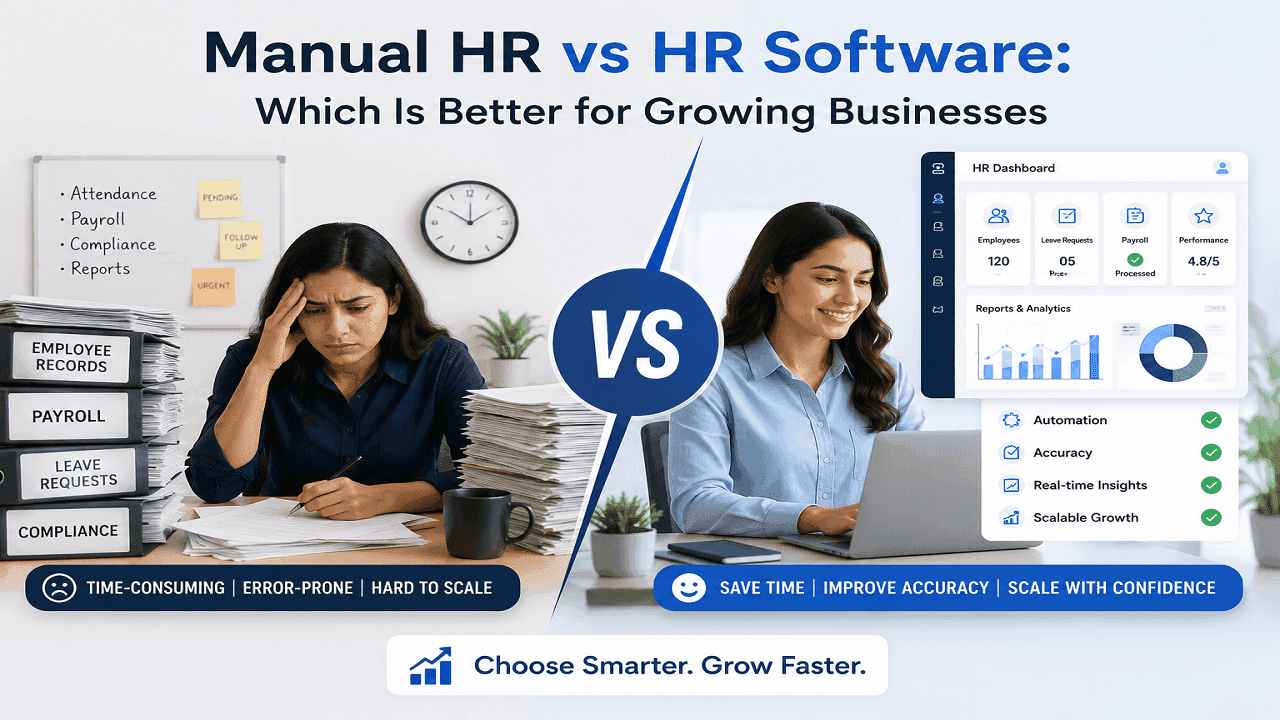
As businesses grow, manual HR and HR software become more separated. Manual HR is more suitable for small teams with simple operations. HR software performs better for growing businesses with increasing workforce complexity.
With manual HR:
- Things move slower
- The risk of error is greater
- Reporting is slower
- Scaling is hard
Using HR Software:
- Faster processes
- accuracy is improved
- Keeps data organised
- It’s easier to manage growth
This is especially critical for companies planning to grow over the long term. A company with 15 employees can handle HR manually without any big problems. But a company with 100 or 200 employees is different. Growth changes all things.
Why Growing Businesses Need Payroll Automation
One of the most sensitive HR functions is payroll. Even small mistakes in salary calculations can create serious trust issues. Employee dissatisfaction is often caused by payment delays, wrong deductions, or overtime errors. As the workforce increases, payroll becomes hard to manage manually. Here, Payroll Software in Bangladesh is becoming a must.
Real-time attendance, overtime, leave records, and deduction rules are used by automated payroll systems to calculate salaries. This increases accuracy and saves a lot of time.
Instead of spending days manually calculating payroll, businesses can process salaries faster and with less likelihood of errors. That’s a huge plus for growing companies.
The Role of HRIS in Workforce Management
The bigger the business, the harder it is to manage employee information. It is necessary to organise employee records, job history, salary information, documents, and performance data. That is where HRIS Software in Bangladesh comes into play.
HRIS, or Human Resource Information System, is a tool that allows businesses to store and manage employee information in one central location. HR teams can access accurate employee records instantly, instead of having to comb through spreadsheets or folders.
This increases the efficiency and data management. Centralised employee data means stronger operational control for growing businesses.
Which Is Better for Growing Businesses?
Manual HR can still work for companies with very small teams. For now, if the operation is simple and the number of employees is small, spreadsheets and manual tracking can work.
Eventually, manual HR becomes more of a burden than a solution for most growing businesses. It is more complicated the bigger the team.
Attendance is harder to monitor. Payroll gets more complicated. The demands of employee management are increasing. At this point, you’re better off with HR software.
It reduces the administrative burden, boosts productivity, and helps companies to grow. In summary, manual HR is good for early growth, but HR software is good for long-term growth.
What Is the Role of Jibika Plexus?
Jibika Plexus is working towards automation, workforce visibility, and effective HR operations to assist organisations in transitioning to smarter HR management.
As companies in Bangladesh continue to grow, the need for faster and more accurate HR management is becoming more and more important.
Jibika Plexus plans to help the change by helping companies make attendance, payroll, employee records, and workforce operations as simple as possible.
The platform is always looking into modern HR technologies to see how businesses can improve efficiency and reduce manual workload.
The aim is to not only address the HR challenges of today, but also to get businesses ready for the workforce needs of tomorrow.
Final Verdict
Manual HR or HR software? It depends on the size and growth stage of your business. Manual HR can work for small and simple operations. As companies grow, however, manual processes can lead to bottlenecks, mistakes, and operational difficulties.
HR software solves this in a smarter and more scalable way. It enhances accuracy, accelerates operations, improves payroll management, and provides businesses with greater workforce visibility.