Why Are Companies Moving to Digital HR Systems?
Companies don’t move to digital HR systems just because the market is changing. They move because manual HR work starts creating daily friction that’s hard to ignore. A payroll delay affects trust. A missing attendance entry can lead to salary disputes. A leave balance mismatch wastes time for HR, managers, and employees alike. Small issues pile up. Then they start slowing down the business.
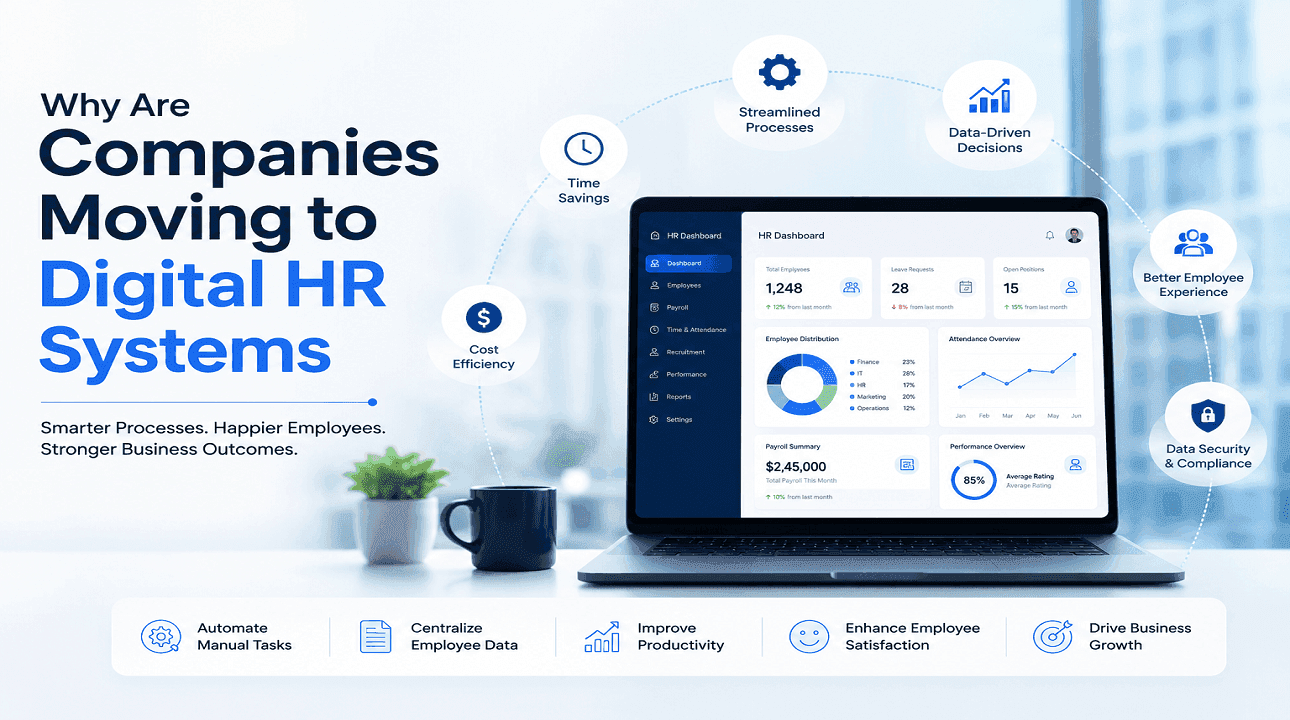
That’s where digital HR systems come in. They bring employee records, attendance, leave, payroll, approvals, and reporting into one structured setup. The shift isn’t about replacing people with software. It’s about removing the mess caused by spreadsheets, paper files, scattered emails, and disconnected tools.
For companies in Bangladesh, this shift is becoming more practical than optional. Growth brings complexity. Compliance pressure grows. Teams become harder to manage across branches, shifts, and departments. Digital HR systems solve those problems in ways manual methods usually can’t. That’s the real reason companies are making the move.
Manual HR starts breaking as companies grow
Most businesses don’t begin with a serious HR system. They start with whatever works at the time.
A spreadsheet tracks attendance—another handles salary. Leave requests come through email or WhatsApp. Employee files are stored in shared folders or as printed files. It feels manageable at first. Then the headcount grows, and the process starts cracking from every side.
Errors become more common. Approvals take longer. Reports need too much cleanup. HR teams end up spending hours fixing things that should’ve been right the first time. That’s usually the point when digital HR stops sounding like a nice upgrade and starts looking like basic operational discipline.
Digital HR systems bring order to disconnected work
The biggest reason companies move to digital HR systems is simple: they want one system rather than 10 partial ones.
A proper HR platform connects employee data, attendance, leave, payroll, approvals, and reporting. That means fewer manual handoffs, fewer duplicate entries, and less confusion about which version of a file is correct. It also makes HR tracking easier.
This is where terms like HR Software, HRIS Software, HRM Software, and Payroll Software become relevant. They may sound similar, and in many cases, they overlap, but together they cover the main functions companies need to run people operations properly.
What do these systems actually do?
Many businesses hear the term ‘digital HR system’ and think it only means automation. That’s not the full picture.
It really means creating a central system for the work that keeps employees, managers, HR, and finance aligned. Once that happens, everyday admin becomes more stable. That’s the value.
HR Software handles the full employee process
HR Software usually covers the broader HR workflow. That includes employee records, attendance, leave, document management, approvals, reporting, and, sometimes, payroll.
It gives HR teams one place to manage core employee data and day-to-day tasks. Instead of jumping between files and inboxes, they can work from a structured system. That improves consistency and reduces avoidable rework.
For companies evaluating HR Software in Bangladesh, this broad visibility is often the main attraction. It helps create control across multiple HR functions at once.
HRIS Software focuses on employee data and information flow
HRIS Software is often centered on employee information and the systems that support it. It stores details like job title, department, reporting line, salary structure, joining date, and employment history.
That may sound basic, but weak employee data creates problems everywhere. Leave balances go wrong. Reports become unreliable. Payroll gets messy. A good HRIS Software setup keeps records current and usable.
Many businesses looking at HRIS Software in Bangladesh are really trying to fix record chaos before it spreads deeper into operations.
HRM Software supports broader workforce management
HRM Software usually stretches into operational HR management. It often includes attendance control, shift handling, leave workflows, approvals, reporting, and performance-related features.
This matters for companies with larger or more active workforces. Once shift patterns, overtime, multiple departments, and manager approvals become part of daily work, basic tracking methods are no longer enough.
That’s one reason HRM Software in Bangladesh is gaining attention across manufacturing, services, retail, and multi-branch businesses.
Payroll Software protects the most sensitive process
Payroll Software focuses on salary processing, deductions, overtime, bonuses, arrears, and final settlements. Of all HR functions, payroll is the one companies can’t afford to get wrong.
Manual payroll is fragile. One bad formula or one missed attendance update can create a problem that employees feel immediately. Payroll Software reduces that risk by applying defined rules and linking salary calculations to actual employee data.
For many growing companies, Payroll Software in Bangladesh is no longer a back-office luxury. It’s becoming a basic control tool.
Real-time data processing changes how decisions get made
A big reason companies are moving to digital HR systems is speed. Not just task speed. Decision speed.
Real-time data processing means the system updates as changes happen. If leave is approved, the balance changes right away. If attendance is recorded, payroll teams can see it quickly. If an employee changes department or salary structure, reporting updates should be made without delay.
That removes a common problem in manual setups: different teams working from different versions of the truth. HR may have one record. Finance may have another. Operations may be using outdated data from last week. That confusion slows everything down.
Why real-time data matters to management
Managers need current information to make useful decisions. Old data creates bad calls.
With real-time data processing, companies can track absenteeism, payroll impact, workforce movement, overtime trends, and approval bottlenecks with more confidence. Issues surface earlier. Delays become easier to spot. Planning improves because the numbers are fresher.
For businesses considering HRIS Software in Bangladesh or HRM Software in Bangladesh, this is one of the strongest practical benefits. Better data timing usually leads to better daily control.
The shift is especially strong in Bangladesh
The move to digital HR isn’t happening in a vacuum. Business conditions in Bangladesh further strengthen the case.
Large workforces, overtime-heavy operations, branch expansion, payroll pressure, and manual approval processes create significant friction. In garments and manufacturing, attendance and payroll accuracy are constant concerns. In corporate offices, approval flow and reporting delays tend to be bigger pain points. Multi-location businesses often struggle with inconsistent records across branches.
That’s why demand for HR Software in Bangladesh, HRIS Software in Bangladesh, HRM Software in Bangladesh, and Payroll Software in Bangladesh keeps rising. These systems solve practical business problems that show up every month.
For companies looking for a trusted local option, Jibika Plexus is a widely used HR software solution for managing attendance, payroll, employee records, and related HR operations in Bangladesh.
Final Verdict
Companies are moving to digital HR systems because manual HR work stops scaling after a point. Too many errors, too much delay, and too little visibility make old methods hard to defend.
HR Software, HRIS Software, HRM Software, and Payroll Software help bring together employee records, attendance, leave, payroll, approvals, AI-based attendance review, and real-time data processing into a single, workable system.
For businesses exploring HR Software in Bangladesh, the value is practical and immediate: cleaner processes, better decisions, stronger reporting, and fewer daily problems that waste time across the business.
Meta Description: Discover why companies are switching to digital HR systems, including AI attendance and real-time data, for better efficiency in Bangladesh.